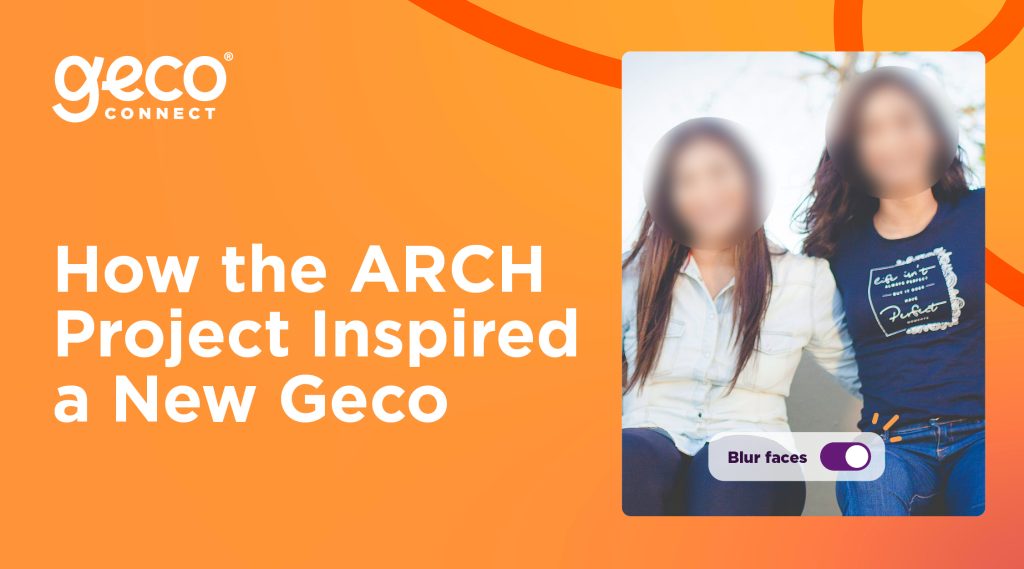
Geco Connect has launched a new way to protect children’s identities in photos held within care records, evidence and reporting. Innovation in children’s services doesn’t happen in isolation.
Some of the most important advances begin with research—asking difficult questions, exploring complex challenges and developing new ways to better support children and young people.
One project making a significant contribution in this area is the ARCH (Archiving Residential Children’s Homes) Project, led by researchers at the University of Stirling in partnership with the University of Osnabrück. Over three years, the project has explored how technology can help preserve the everyday experiences of children living in residential care, while carefully balancing ethics, privacy and identity.
At Geco Connect, we’ve been following the project’s work with great interest.
Turning Research into Practice
One area of the ARCH Project particularly resonated with our development team: protecting the identities of children and young people while still allowing important memories and experiences to be safely recorded and shared.
The project’s Memory Bank software allows individuals to opt in or out of appearing in photographs by blurring individual faces, enabling group memories to be preserved while respecting privacy and personal choice.
We recognised that this principle could have valuable applications beyond digital memory archives.
Inspired by this approach, we’ve developed similar functionality within Geco Connect.
How Geco Connect Helps Protect Children’s Identities in Photos
Users can now selectively blur the faces of children, young people or other individuals within photographs where identities need to be protected. This allows organisations to safely use images within records, evidence and reporting while maintaining confidentiality and respecting the wishes of those involved. In short, it gives staff a simple way to protect children’s identities in photos without losing the value of the visual record.
Importantly, this functionality has been developed within Geco Connect’s secure platform, ensuring organisations can benefit from enhanced privacy controls while continuing to meet the high standards expected across children’s services.
Learning From the Sector
The ARCH Project highlights the importance of designing technology alongside ethical thinking.
As the researchers themselves acknowledge, protecting identity while preserving experiences is one of the project’s central challenges, requiring careful consideration of privacy, consent and access to information.
Those are challenges shared across children’s services every day.
At Geco Connect, we’re committed to learning from research like this and exploring how evidence-based ideas can become practical tools that support professionals in their day-to-day work.
Why This Matters Across the Sector
Photographs play an important role in care records, incident reports and evidence gathering, but they can also carry real risks when a child’s identity is visible. A single image, shared or stored without care, can compromise a young person’s safety, privacy or sense of control over their own story.
Being able to protect children’s identities in photos while still keeping an accurate visual record gives organisations a practical way to balance transparency with safeguarding. Staff no longer have to choose between removing an image entirely and leaving a young person’s face exposed in a document that may be viewed by multiple people over time.
This kind of thinking reflects wider conversations happening across the residential care and education sector, where professionals are increasingly asked to weigh evidence, accountability and privacy against one another. We hear this regularly from the practitioners we work with, including in our Voices of the Sector series, where professionals share how these pressures play out in daily practice.
Features like this are only useful if they fit naturally into existing workflows, which is why the new tool has been built directly into Geco Connect’s secure platform rather than as a separate add-on.
Thank You to the University of Stirling
We’d like to recognise the outstanding work being carried out by Professor Ruth Emond and the wider ARCH Project team at the University of Stirling, alongside their partners.
Research like this helps move the entire sector forward.
By exploring new ideas, challenging existing practice and addressing complex ethical questions, projects like ARCH create opportunities for organisations like ours to translate research into secure, practical solutions that ultimately benefit children and young people.
We look forward to continuing to learn from the ARCH Project and finding new ways to bring innovative, research-led thinking into Geco Connect.
If you’d like to book demo to see how Geco Connect works, get in touch.

 Residential Care Insights






 Care Professionals